

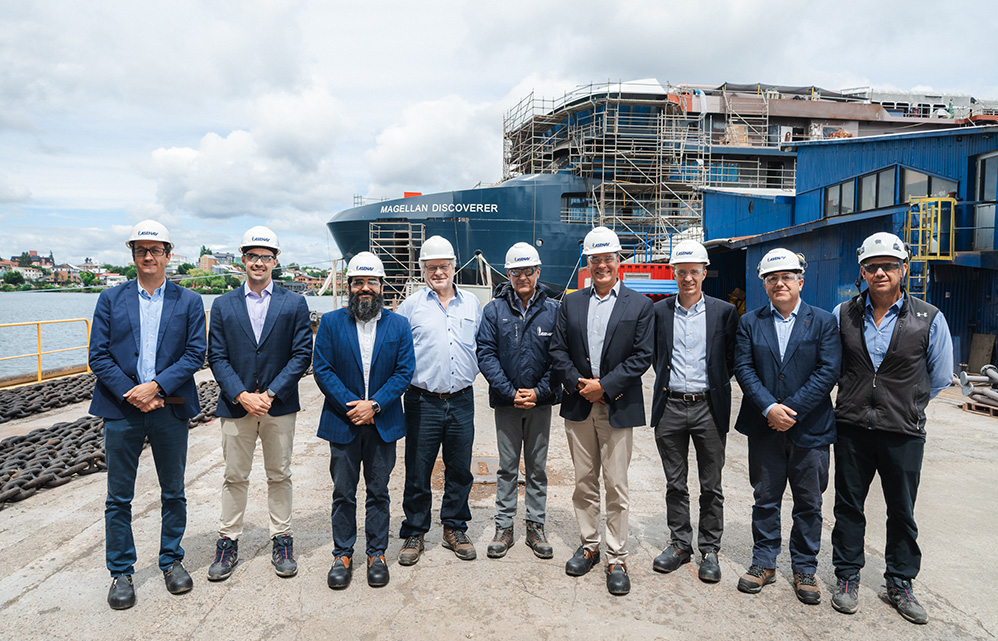
The vessel meets the demanding IMO Tier III international environmental standards and is a key component of efforts to support the Chilean Shipbuilding Plan.
Valdivia, Chile. January 12, 2026. In a strategic step to consolidate the country’s industrial and export capacity, the ASENAV shipyard and multinational towage services company SAAM signed their first shipbuilding contract.
The agreement outlines the manufacturing of a state-of-the-art tugboat in Valdivia, designed under the strictest international standards. Construction is expected to take approximately 15 months, with the vessel scheduled to join SAAM’s fleet in Canada during the first half of 2027.
SAAM CEO Macario Valdés emphasized that “this agreement is good news for Chile. It not only demonstrates that the country has the industrial and technological capabilities to compete in demanding markets, but also highlights the value of decentralization and local development. Building this ship in Valdivia will create jobs, activate regional suppliers and strengthen an industry that can reach the world market. For SAAM, this is a concrete sign that sustainable growth also involves boosting local and regional capacities.”
For his part, the CEO of ASENAV, Fernando Rodríguez, commented, “This project will be an important way to showcase the shipyard, not only as our first collaboration with a company of SAAM’s caliber, but also because it reaffirms our capacity to manufacture vessels that meet the global industry’s most demanding standards. The RAstar 3200-W tug reflects the quality of our Chilean engineering and will make a key contribution to our strategic partner’s global operations.”
State-of-the-art technology and sustainability
The vessel, a RAstar 3200W model designed by Robert Allan, will be 32 meters long and have over 80 tons of bollard pull. The unit will be equipped with a constant tension winch for escort operations and a fire extinguishing system with Fire-Fighting Class 1 notation.
One of the highlights is its commitment to decarbonization: the ship will feature an advanced waste gas treatment system to separate nitrous oxides, complying with the demanding IMO Tier III regulations, which will significantly reduce pollutant emissions.
Designed and rated especially for challenging “escort” type indirect pulling maneuvers, this tug increases safety in operationally demanding areas. In addition, it boasts an enhanced beam compared to its original design, which improves stability and crew comfort, making this vessel a versatile platform for harbour operations, mainly to assist vessels at specialized hydrocarbon terminals.
Non-traditional exports and regional development
This agreement is part of the Chilean Shipbuilding Plan, a government initiative to promote the local industry beyond the construction of warships, driving the development of civil shipbuilding to meet global requirements.
Construction in Valdivia will provide a direct boost to the regional economy, activating an ecosystem of local suppliers and specialized jobs. The vessel should be completed and ready for delivery during the first quarter of 2027.
The agreement also takes advantage of Chile’s Free Trade Agreement (FTA) with Canada.


